
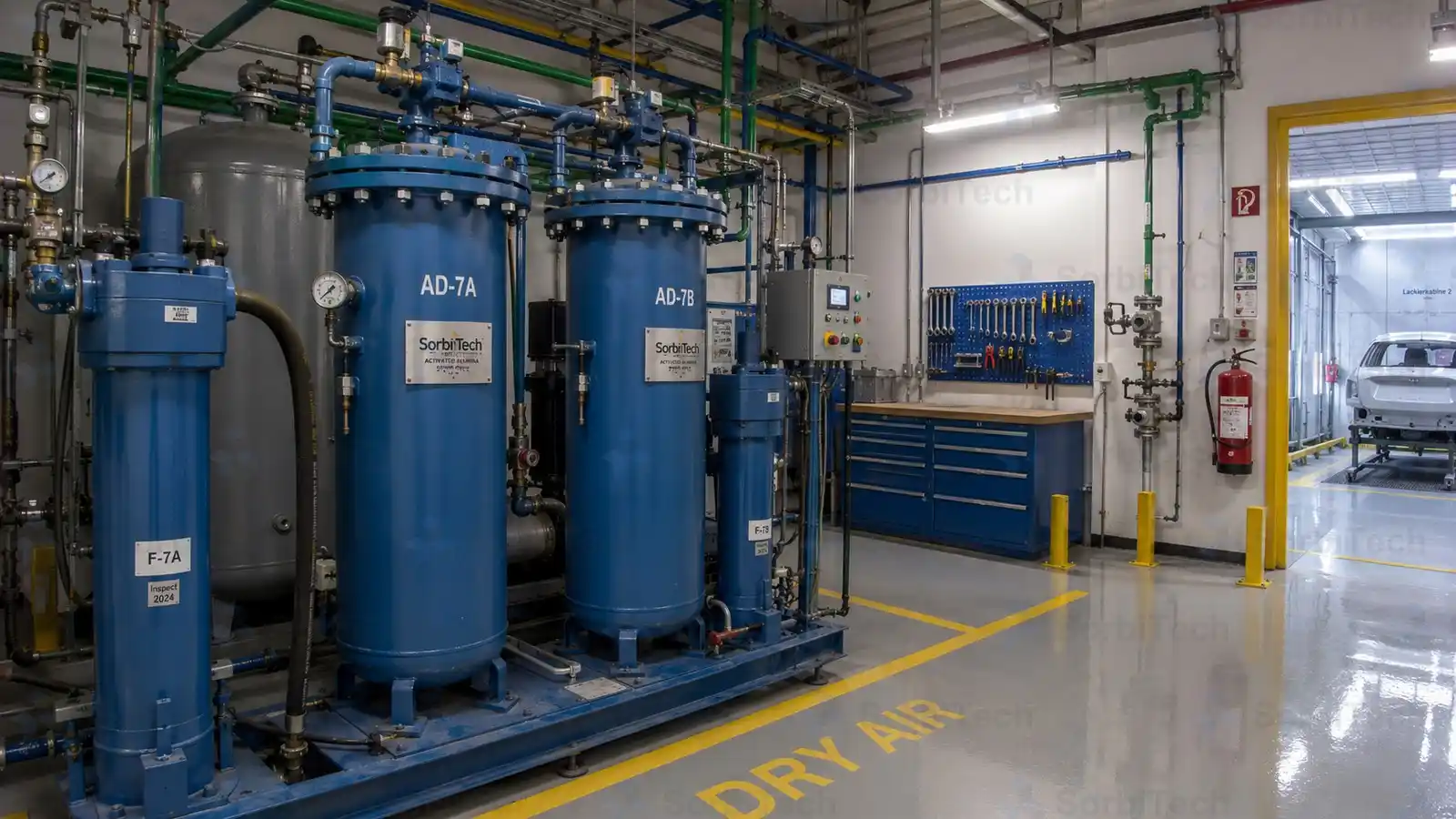
Pressure dew point decides the fill, not the model number on the cabinet
A desiccant dryer is specified around the pressure dew point the plant downstream has to see. Two dryers of the same nominal rating, set for different dew points, hold different media, and the model designation on the enclosure does not distinguish them. The starting question at changeout is therefore what the air has to reach at the outlet, and only then what the tower is.
The Atlas Copco desiccant ranges cover both regeneration methods. The CD family regenerates without added heat, using a share of the dried air as purge. The BD family uses heated ambient air from a blower, which recovers most of that purge loss. Both are twin tower machines holding a bulk fill that is recharged over the life of the unit, and the dew point band each is set for is what governs the grade going back in.
Media supplied for each pressure dew point band
The bands below are the ones desiccant dryers are normally configured around, expressed against the water classes in ISO 8573-1. Properties are typical SorbiTech figures and are confirmed on the certificate of analysis for the batch supplied.
| Pressure dew point | ISO 8573-1 water class | Media normally supplied | Typical properties |
|---|---|---|---|
| Around -20 °C | Class 3 | Activated alumina drying grade | 3 to 5 mm or 5 to 8 mm spheres, bulk density around 0.75 to 0.82 g/ml, BET around 320 to 380 m²/g |
| Around -40 °C | Class 2 | Activated alumina drying grade, with silica gel where the inlet runs warm | Alumina water capacity around 20 percent and above. Silica gel carries around 30 percent at 80 percent relative humidity, with a lower regeneration temperature |
| Around -70 °C | Class 1 | Activated alumina with a molecular sieve 4A layer at the outlet end | 4 Å pore opening, water capacity around 22 percent and above, bulk density around 0.66 to 0.72 g/ml |
Indicative bands. The grade is confirmed against the measured duty of the individual unit, since inlet temperature, operating pressure and cycle all move the working capacity available.
Full data sits on the activated alumina, silica gel and molecular sieve product pages. The duty itself is covered under compressed air drying and purification. Where the selection is being made from first principles rather than against an installed machine, the reasoning is set out in choosing a desiccant by dew point.
A layered fill puts molecular sieve where the air is already dry
Deep dew point duties are not usually met by filling the whole tower with molecular sieve. Alumina holds a large mass of water cheaply and releases it at a moderate regeneration temperature, so it does the bulk work at the inlet end where the air is still wet. Molecular sieve holds the last traces tightly at very low water partial pressure, which is exactly the condition at the outlet end, and that is where a thinner layer of it earns its cost.
The split between the two materials is set by the duty rather than by a fixed ratio, and both layers have to be replaced together. Returning only the sieve layer while leaving aged alumina underneath moves more of the water load onto the sieve than it was sized for.
Heatless and heated regeneration ask different things of the desiccant
The two regeneration methods put quite different loads on a fill, and the same nominal grade can behave differently in each. The properties worth checking before ordering are set out below.
| Regeneration method | What the bed experiences | Property that carries the load |
|---|---|---|
| Heatless, purge regenerated CD type machines | Short cycles, often a few minutes, repeated continuously. Rapid depressurisation and repressurisation on every changeover | Crush strength and attrition resistance. SorbiTech alumina drying grade is supplied at around 130 N and above per sphere, since the cycle count over a year is high |
| Heated, blower purge BD type machines | Longer cycles with a heated regeneration step, so fewer mechanical events but a repeated thermal swing | Regeneration temperature range. Alumina regenerates at around 175 to 250 °C, molecular sieve 4A at around 200 to 315 °C, silica gel considerably lower at around 120 to 180 °C |
Silica gel is the reason the regeneration temperature matters at the ordering stage. It performs well on a heatless machine and on warm inlet air, but its regeneration range sits below the temperature a heated dryer may apply.
One class of machine is worth separating out. Rotary drum dryers, including the MD range, hold their desiccant in a rotating drum rather than as a bulk fill in twin towers, so they are not recharged in the same way as a CD or BD unit. Confirming the dryer type from the nameplate before ordering avoids that mismatch.
A top up and a full change are not the same job
Desiccant levels fall over time through settling and through fines carried out on the purge, and topping the tower back to its original level is a common response. It is the right response only in a narrow set of circumstances, because new media added on top of an aged bed does not restore the bed as a whole.
- A top up suits early mechanical loss. Where the level has dropped within the first part of the fill life, the media below is still performing, and the same grade is going back in, adding to the level is reasonable and inexpensive.
- A full change suits a bed that has stopped holding dew point. Once capacity has fallen the aged fraction still limits the outlet, whatever is added above it, so the result of a top up is a tower at the correct level that still misses its specification.
- Only a full change gives a recorded fill weight. With the tower empty the bed can be levelled and the actual weight taken, which is what makes the next changeout predictable rather than estimated.
- Layered fills are always changed complete. The proportion between the two materials is part of the design, and it cannot be maintained by adding to one of them.
Dew point drifting early usually points upstream
A fill that reaches the end of its useful life gradually is behaving normally. One that loses dew point well before the expected interval is usually reporting a condition ahead of the dryer rather than a fault in the media, and a replacement charge installed without correcting that condition will decline the same way.
- Oil carryover from the compressor. Oil coats the surface and blocks access to the pore structure. The effect is permanent, and the spent media usually shows discolouration through the inlet section.
- Liquid water reaching the bed. Slugs of liquid rather than vapour cause alumina spheres to fracture, which produces fines, raises pressure drop and lets flow channel through the bed.
- Prefilter and drain condition. A blocked drain or a filter element past its life puts both of the above into the tower, so the condition of that equipment is part of the same enquiry.
- Inlet temperature above the design figure. Warm air carries more water, so the same bed is being asked to hold a larger load per cycle than it was sized for.
The condition of the spent charge distinguishes these. Discolouration through the inlet section points to oil, while broken spheres and fines point to liquid water or to mechanical stress. Related duties are covered under instrument and plant air drying and, where a new package is the better answer, the heatless desiccant air dryer system page.
What to send with an enquiry
A short set of information is enough to return a grade and an indicative quantity for a CD or BD unit.
| Information | What it determines |
|---|---|
| Dryer model and regeneration type | Whether the unit holds a bulk twin tower fill, and what the media will be asked to withstand |
| Pressure dew point the plant has to meet | The primary driver of the grade, and whether a layered fill applies |
| Inlet flow, pressure and air temperature | The water load arriving per cycle, and the working capacity available |
| Tower internal diameter and bed height | Fill volume, which converts to charge weight through bulk density |
| Media currently installed and years in service | Separates normal ageing from a condition upstream of the dryer |
Where tower dimensions are not to hand they can be established when the unit is opened, so a missing drawing does not hold up a quotation. Other equipment classes are listed on the compatible media directory, and units running on carbon molecular sieve rather than a desiccant are covered under carbon molecular sieve for Atlas Copco nitrogen generators.
Compatibility and supply
SorbiTech activated alumina, silica gel and molecular sieve are manufactured to SorbiTech's own specification and supplied as compatible charges for desiccant air dryers built by other manufacturers, including CD and BD series units from Atlas Copco. Grades are selected against the duty of the individual unit and released with a certificate of analysis.
Engineering design, technical support and performance guarantees are available, and are set against the specific unit and duty following technical review.
Where a unit remains under an original manufacturer warranty or service agreement, the terms of that agreement apply.
Frequently asked questions
Which media suits a dryer set for -40 °C
Activated alumina drying grade is the usual selection at that dew point, supplied as 3 to 5 mm or 5 to 8 mm spheres with a bulk density around 0.75 to 0.82 g/ml and a water capacity around 20 percent and above. Where the inlet air runs warm, silica gel is sometimes preferred for its higher capacity at elevated humidity, provided the regeneration temperature applied stays inside its range.
When a molecular sieve layer is needed
At the deeper dew points, around -70 °C and class 1 under ISO 8573-1. Molecular sieve 4A holds water tightly at very low partial pressure, which is the condition at the outlet end of the bed, so a thinner layer is placed there while activated alumina carries the bulk of the load at the inlet end.
Whether a top up is enough
Only where the level has fallen through settling early in the fill life and the media below is still performing. Once the bed has stopped holding dew point, the aged fraction continues to limit the outlet whatever is added above it, so the tower ends up at the correct level and still misses its specification. Layered fills are always changed complete.
How the charge weight is worked out
From the internal volume of the tower and the bulk density of the grade supplied. Because the materials sit at different densities, roughly 0.75 to 0.82 g/ml for alumina against 0.66 to 0.72 g/ml for molecular sieve 4A, a like for like weight order across a change of media will not fill the tower to the same height.
Why a dryer loses dew point earlier than expected
Usually a condition ahead of the dryer rather than the media itself. Oil carryover coats the surface and blocks the pore structure, and liquid water reaching the bed fractures alumina spheres and generates fines. The condition of the spent charge distinguishes the two, and correcting the cause matters before a replacement charge goes in.
Whether every Atlas Copco dryer holds a replaceable fill
No. Rotary drum types, including the MD range, hold their desiccant in a rotating drum rather than as a bulk fill in twin towers, so they are not recharged in the same way as a CD or BD unit. Confirming the dryer type from the nameplate is the first step.
Specify a desiccant charge for your dryer
Tell us the pressure dew point the dryer has to hold and the tower dimensions, and we will confirm the grade, the layer arrangement and the quantity.