
The target dew point decides the media, not the price per kilogram
Desiccant selection is often argued as though one medium were simply better than the others. In practice the three common industrial desiccants do not compete for the same duty. Each holds water by a different mechanism, and each is the strongest performer in a different part of the moisture range. The useful question is not which desiccant is best, but where on the dew point scale the process has to end up.
A practical dividing line sits at about minus 40 °C. Above it the duty is bulk water removal, and equilibrium capacity is the governing property. Below it the residual moisture is so low that only a medium with a strong affinity at very low partial pressure will keep pulling water out of the stream. That single number settles most selections, which is why a specification for gas treatment and drying is normally written on outlet dew point rather than on the material itself.
The three media compared on the properties that decide a design
Set side by side, the differences are easier to weigh than any single headline figure. The values below are broad industry ranges given for orientation, not product specifications.
| Property | Silica gel | Activated alumina | Molecular sieve |
|---|---|---|---|
| Structure | Amorphous silicon dioxide | Porous aluminium oxide | Crystalline zeolite, uniform pore |
| Water capacity, saturated gas | Highest of the three | Typically above 20 percent by weight | Moderate |
| Water capacity, nearly dry gas | Low | Moderate | Highest of the three |
| Practical outlet dew point | To around minus 40 °C | To around minus 40 °C | Below minus 40 °C, commonly to minus 70 °C or lower |
| Typical regeneration temperature | Around 120 to 150 °C | Around 150 to 200 °C | Around 200 to 300 °C |
| Tolerance of liquid water | Limited on some grades | Good | Good, confirm by grade |
| Mechanical strength | Moderate | High, crush strength commonly above 130 N | Moderate to high |
| Selective by molecule size | No | No | Yes, set by pore size |
Ranges are indicative and vary by grade and manufacturer. Confirm against the data sheet for the specific product and duty.
Silica gel carries the most water when the gas is genuinely wet
Silica gel is an amorphous form of silicon dioxide with a very large internal surface. It holds water by physical condensation in its pores, so capacity rises steeply as relative humidity rises. In a saturated or near saturated stream it will typically take up more water per kilogram than either of the other two media, which makes it efficient where the incoming load is high and the required outlet dew point is moderate. Its comparatively low regeneration temperature, commonly in the region of 120 to 150 °C, also makes it inexpensive to cycle.
That same mechanism sets the limit. As the gas becomes drier the driving force falls away quickly, and by roughly minus 40 °C the equilibrium capacity is largely spent. Silica gel is therefore well suited to bulk moisture duty, to protective packaging, and to the small breather cartridges used on transformer breather systems, where a colour change gives an at a glance indication that the charge is exhausted.
Grade selection within the family is usually about whether that visual indication is needed rather than about capacity. Non indicating white silica gel is the standard fill where no indication is required, blue indicating silica gel uses a cobalt chloride indicator, and cobalt free orange silica gel gives the same visual cue where the cobalt compound is not acceptable on toxicity grounds.
One practical caution applies. Because water is held in a liquid like state in the pores, direct contact with free liquid can shatter the granules of some grades. Where slugs of water are possible the bed should be protected upstream, or a more tolerant medium chosen.
Activated alumina holds up where the load is heavy and the conditions are rough
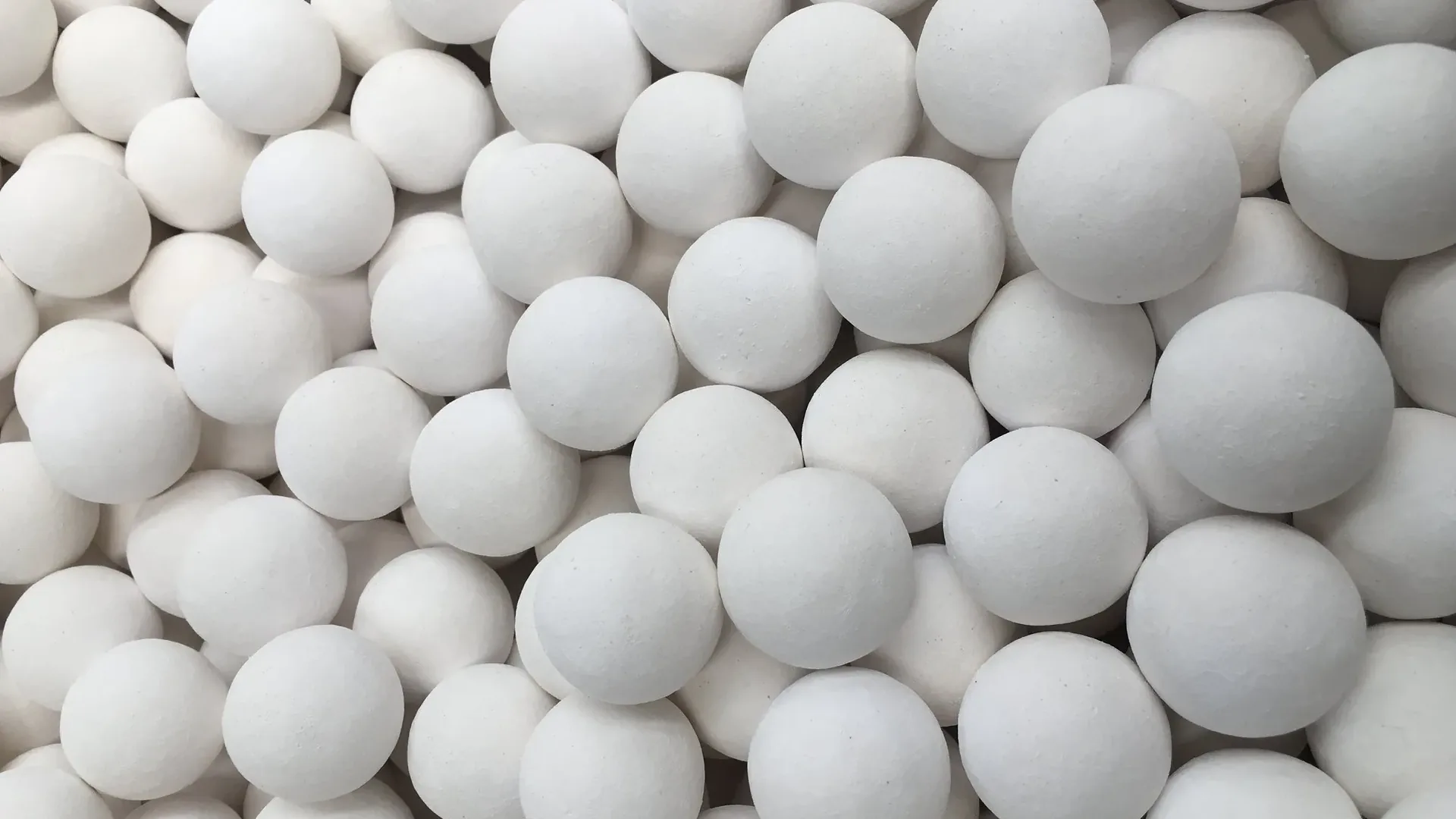
Activated alumina is a porous aluminium oxide supplied as spheres. Water capacity is typically above 20 percent by weight, below silica gel in a saturated stream, but it brings two properties that matter in industrial service. It is mechanically strong, with crush strength commonly above 130 N, and it tolerates contact with liquid water far better than silica gel. It also holds useful capacity at higher operating temperature, where silica gel begins to fall away.
That combination is why an activated alumina drying grade is the standard fill for compressed and instrument air dryers, where a dew point near minus 40 °C is required from a saturated inlet and the bed is cycled many times a day for years. A controlled sphere size and a verified attrition standard matter as much as the capacity figure here, because it is attrition that gradually raises pressure drop and generates the fines that foul downstream valves. Where a higher performance fill is justified, AloxSorb F is specified for the same duty.
Activated alumina also has surface chemistry that silica gel does not. It will retain fluoride, arsenic and acidic species, which is why the same base material appears in fluoride removal from drinking water and in arsenic removal as well as in gas drying, and why an impregnated activated alumina is used as a guard bed against hydrogen chloride and hydrogen fluoride. A medium that can do two jobs in one vessel is frequently the economic answer even when it is not the highest capacity option.
Molecular sieve is what takes the stream below minus 40 °C
Molecular sieves are crystalline zeolites with pores of a precise and uniform size. Because the pore structure is a defined crystal rather than a distribution, a sieve keeps a strong affinity for water even when very little water is left in the gas. That is what allows it to go on drying long after the other two media have reached equilibrium, and it is the reason a sieve is specified whenever the target is a deep dew point, as in natural gas dehydration ahead of cryogenic processing.
The precision of the pore also makes the medium selective, so the grade is chosen by what has to be excluded as much as by what has to be removed.
| Grade | Nominal pore | Typically selected for |
|---|---|---|
| Molecular Sieve 3A | About 3 angstrom | Drying where larger molecules must be kept out of the pore, including ethanol dehydration and unsaturated hydrocarbon streams |
| Molecular Sieve 4A | About 4 angstrom | General drying of sweet gas, refrigerants and sealed units |
| Molecular Sieve 5A | About 5 angstrom | Separations where slightly larger molecules must enter the pore, including some pressure swing duties |
| Molecular Sieve 13X | About 10 angstrom | Simultaneous water and carbon dioxide removal, as in cryogenic air pre purification |
Pore sizes are nominal. Confirm grade selection against the actual composition and the contaminants present.
The trade off sits at the wet end. A sieve does not hold as much bulk water as silica gel in a saturated stream, and it binds the water it does adsorb more tightly, so regeneration needs a higher temperature, commonly in the region of 200 to 300 °C. That energy has to be available on site before the medium can be specified.
Capacity comparisons only mean something at a stated humidity
Most disagreements about which desiccant has the higher capacity come from comparing figures taken at different conditions. Plotted against relative humidity the three curves have distinctly different shapes, and each medium is the strongest performer somewhere on the chart.
Read from the left, the sieve is far ahead in dry gas. Read from the right, silica gel carries the largest load in wet gas. Activated alumina runs between them and is rarely the weakest choice at either end, which is part of why it is so widely used.
Compressed air duties are specified against ISO 8573-1 humidity classes
For compressed air drying and purification the requirement is normally expressed as an ISO 8573-1 class rather than as a raw number, and the class translates directly into a media choice. The humidity classes are defined by pressure dew point, so reading the class first removes most of the guesswork.
- Class 4, pressure dew point at or below +3 °C. Generally a refrigeration duty rather than an adsorption one.
- Class 3, at or below minus 20 °C. Comfortably within reach of silica gel or activated alumina.
- Class 2, at or below minus 40 °C. The classic activated alumina duty, and the basis on which most instrument and plant air systems are sized.
- Class 1, at or below minus 70 °C. A molecular sieve duty, often as the upper layer of a layered bed.
Two points are worth carrying into the specification. The class is written on pressure dew point, not atmospheric dew point, and the two are not interchangeable. It is also good practice to design for a margin below the class boundary, because the bed ages and the ambient conditions move.
Demanding duties place two media in the same vessel
Because the strengths sit at opposite ends of the humidity range, the most efficient answer to a demanding specification is frequently not one medium but two, loaded as layers in a single vessel. Wet gas enters through a lower layer of activated alumina, which takes the bulk of the water economically and shields the layer above from liquid carryover and from the worst of the thermal swing. The partially dried gas then passes into an upper layer of molecular sieve, which polishes it to the deep dew point the process requires.
The commercial logic is straightforward. The cheaper and more robust medium does the heavy lifting, and the more expensive medium is reserved for the part of the duty only it can perform. The arrangement is standard in a cryogenic air pre purification package and appears in many gas dehydration designs. It is the clearest illustration of why the three media are better understood as complementary than as rivals.
Regeneration method belongs in the selection, not after it
A desiccant is only half of the decision. How the bed is dried out again determines how much of the rated capacity is actually available, and it differs sharply between the media. Water held loosely, as in silica gel, comes off with modest energy. Water held tightly, as in a molecular sieve, needs a higher regeneration temperature, which is why sieve beds are usually associated with heated cycles.
- Heatless, pressure swing regeneration. A share of the dried product is expanded and passed back through the offline bed. Simple and reliable, and the usual arrangement in a heatless desiccant air dryer filled with activated alumina. The purge loss is the price paid for the simplicity.
- Heated, thermal swing regeneration. A hot purge drives the water off, which suits the tighter binding of a molecular sieve and is the basis of a twin tower thermal swing unit. Purge loss is much lower, at the cost of a heater and a longer cycle.
Thermal stability is the related constraint. Zeolite structures tolerate repeated high temperature regeneration well. Silica gel is the most limited of the three in this respect, so a duty demanding aggressive thermal cycling points toward alumina or sieve regardless of the capacity figures.
Bed sizing is governed by a short list of constraints
Once the medium is chosen the vessel is sized from a small set of limits that stay broadly consistent across gas drying duties. The ranges below are the ones normally used for a first pass. They are a way of arriving at a sensible starting geometry, not a substitute for a rated design.
| Parameter | Typical range | Why it governs |
|---|---|---|
| Superficial velocity | Around 0.1 to 0.3 m/s | Too high and the bed suffers attrition, lifting and a stretched mass transfer zone. Too low and the vessel is needlessly large. |
| Bed depth to diameter | Commonly 2:1 to 3:1, rarely below 1.5:1 | Shallow beds channel, and once the flow distribution is poor the bed never fully recovers it. |
| Bed depth against mass transfer zone | Several times the zone length | The mass transfer zone is the only part of the bed doing work at any moment. A bed barely longer than the zone breaks through almost immediately. |
| Design working capacity | A fraction of equilibrium capacity | Equilibrium figures are measured at rest. A bed on a short cycle never reaches equilibrium. |
| End of life derating | Commonly 30 to 50 percent below fresh | Capacity falls with cycle count, thermal ageing and contamination. Sizing on fresh capacity guarantees an early failure. |
| Pressure drop across the bed | Often held to a few tenths of a bar | Pressure drop is a permanent energy cost for the life of the plant. |
| Cycle time | Heatless, minutes. Heated, hours. | Sets how much water each cycle actually has to carry. |
Ranges are indicative and duty dependent. Confirm every value against the design case and the media data sheet.
One consequence catches people out. In most compressed air duties it is the geometry, not the water balance, that fixes the vessel. The quantity of water removed during a short heatless cycle is small, so velocity and minimum depth end up setting the size, and the bed holds far more desiccant than the water load alone would suggest.
A worked example, from specification to vessel
Following one duty through makes the sequence concrete. The arithmetic below is rounded and indicative, and it is shown to illustrate the method rather than to size a real machine.
| The duty | Value |
|---|---|
| Flow | 1,000 Nm³/h instrument air |
| Pressure | 7 barg, so about 8 bar absolute |
| Inlet condition | Saturated at 35 °C |
| Requirement | ISO 8573-1 Class 2, pressure dew point at or below minus 40 °C |
| Site constraint | No regeneration heat available |
- Choose the medium. Class 2 puts the target at minus 40 °C, which sits at the upper end of the range covered by activated alumina drying grade. The absence of regeneration heat confirms it, because a molecular sieve would want a heated cycle to give up its water.
- Find the water load. The saturation pressure of water at 35 °C is roughly 5.6 kPa. Against 800 kPa total that is about 0.7 percent by mole. A flow of 1,000 Nm³/h is close to 44.6 kmol/h, so the water carried in is around 0.31 kmol/h, or about 5.7 kg/h.
- Convert to a per cycle load. With a five minute adsorption step, each tower has to hold roughly 0.5 kg of water before it swaps over.
- Size the diameter from velocity. At 8 bar absolute and 35 °C the actual volumetric flow is about 143 m³/h, or 0.04 m³/s. Taking a superficial velocity near 0.2 m/s gives a cross sectional area of about 0.2 m², so a vessel of roughly 0.5 m internal diameter.
- Set the depth from the ratio. A depth to diameter ratio of 2 gives a bed about 1.0 m deep, and a bed volume near 0.2 m³.
- Convert to a fill weight. At a bulk density in the region of 750 to 800 kg/m³, that is roughly 150 kg of alumina per tower.
The sense check is the interesting part. Half a kilogram of water on 150 kg of alumina is a loading of about 0.3 percent by weight, far below the equilibrium capacity of the material. That is not an error. It is the normal picture for a heatless dryer, and it confirms the point made above, that geometry rather than the water balance has governed the size. It also explains why heatless units are specified with a purge allowance, commonly in the region of 15 to 20 percent of the product flow, since that purge is what regenerates the offline tower.
Change one line of the specification and the answer changes with it. If the same plant asked for Class 1, at or below minus 70 °C, activated alumina alone would no longer reach the target at any bed depth. The duty would move to a molecular sieve, most likely as the polishing layer of a layered bed, and with it to a heated cycle of the kind used in a twin tower thermal swing unit. One class on a data sheet changes the medium, the vessel and the utilities.
A short sequence settles most selections
In practice the decision resolves quickly once the questions are taken in the right order.
- Fix the outlet dew point, or the ISO 8573-1 class. Above about minus 40 °C, silica gel or activated alumina will normally serve. Below it, plan on a molecular sieve.
- Look at the inlet load and the state of the feed. A heavy or variable water load, or any risk of liquid carryover, favours activated alumina and may justify a layered bed.
- Check what else has to be removed. If carbon dioxide, an acid gas or a specific molecule must go with the water, the pore size of the sieve grade, or an impregnated alumina, becomes the deciding factor.
- Confirm the regeneration available. A site with no heated purge should not be specified a medium that needs one.
- Then compare cost. Price per kilogram is the last question, and it is best judged across the life of the fill rather than at the point of purchase.
Taken in that order the three media stop looking like competing products and start looking like what they are, a set of tools covering different parts of the same problem.
Frequently asked questions
Which desiccant reaches the lowest dew point?
A molecular sieve does. Its crystalline pore structure keeps a strong affinity for water even when very little water remains in the gas, so it continues drying below about minus 40 degrees Celsius where the equilibrium capacity of silica gel and activated alumina is largely spent. Above that range the other two media are often the more economical choice for the same result.
Does a higher water capacity make one desiccant better than another?
Not on its own, because capacity figures are only meaningful at a stated humidity. Silica gel typically holds the most water in a saturated stream, while a molecular sieve holds far more in a nearly dry one. A comparison is only fair when both are quoted at the humidity the process will actually see.
Why do some vessels contain two different desiccants?
Because the strengths sit at opposite ends of the moisture range. A lower layer of activated alumina removes the bulk of the water economically and shields the layer above from liquid carryover, and an upper layer of molecular sieve polishes the gas to the deep dew point. The result usually costs less to own than filling the whole vessel with sieve.
Can silica gel replace a molecular sieve to reduce cost?
Only where the required dew point sits within its working range, broadly above minus 40 degrees Celsius. For a deeper specification the substitution will not reach the target at any bed depth, because the limit is set by equilibrium rather than by residence time. Where the target is moderate, silica gel is frequently the more cost effective fill.
Specifying a desiccant fill for a drying duty
Share your inlet condition, target dew point and regeneration method, and our engineers will advise on a suitable media selection.