
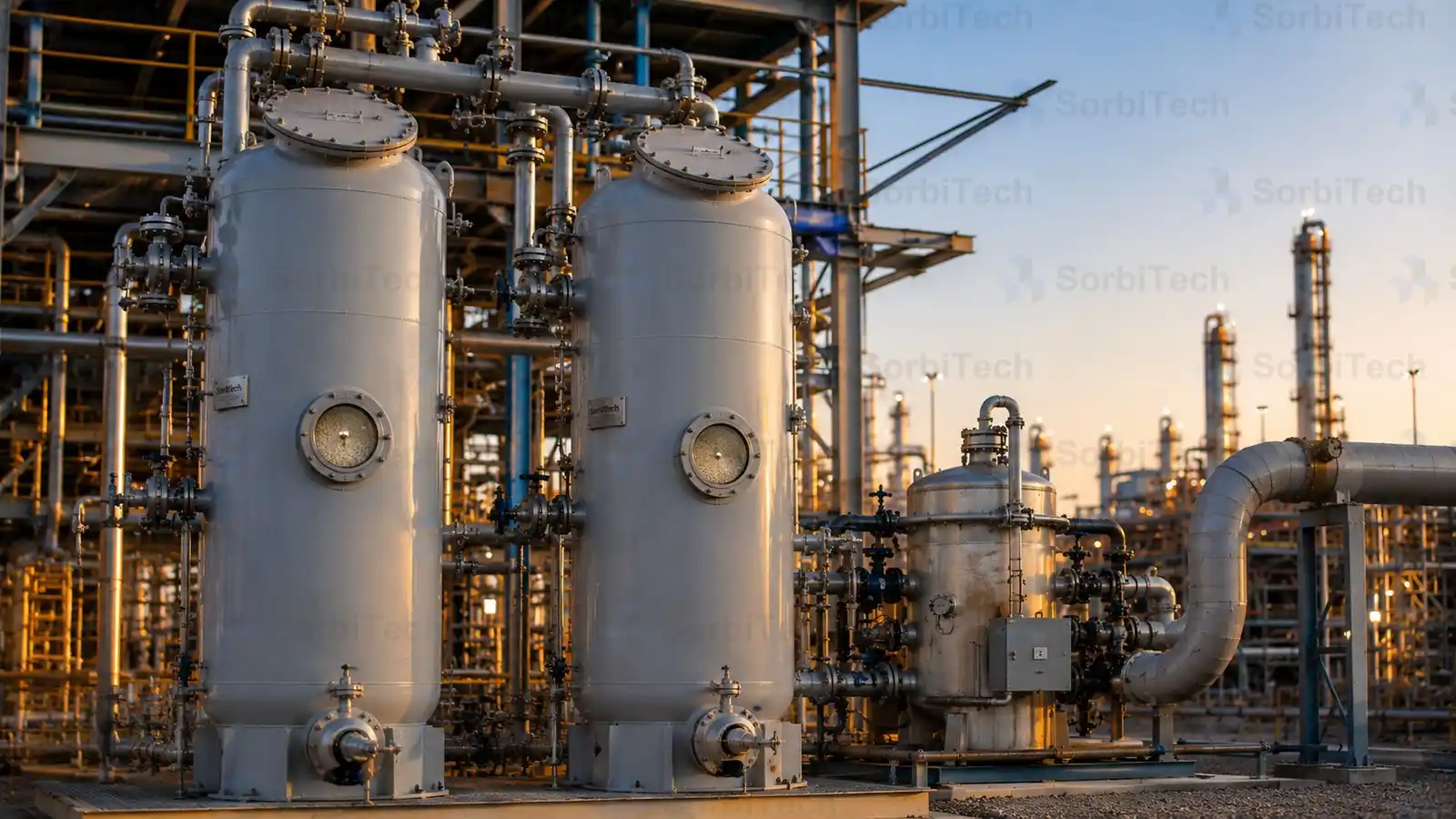
Natural Gas Dehydration
Removing water vapour from natural gas to prevent hydrates and corrosion and to meet pipeline dew point specification, using molecular sieve TSA adsorption.
Natural gas dehydration by adsorption removes water vapour by passing the gas through a packed bed of molecular sieve. Twin tower temperature swing adsorption systems reach outlet water dew points below minus 40 °C at pipeline pressure, which meets GPA 2140 and pipeline operator specifications.
Pipeline Specification and the Hydrate Risk
Gas produced from a reservoir is saturated with water at reservoir temperature and pressure. As that gas cools and is pressurised in the pipeline, the water condenses, freezes against the pipe wall as ice, or combines with light hydrocarbons to form solid hydrates that block valves, instruments, and pig launchers. A sales gas pipeline therefore enforces a contractual water dew point, typically between minus 10 °C and minus 40 °C at line pressure, and a cryogenic gas plant tightens that limit to below minus 70 °C to protect the cold box.
Triethylene glycol contactors remove bulk water economically but cannot reach a low enough outlet dew point for cryogenic service. SorbiTech delivers adsorption on a molecular sieve bed, the only proven technology that meets the full specification reliably at high pressure and over a wide temperature range.
How Adsorption Dehydration Works
Wet gas passes through a packed bed of molecular sieve, which holds water on its internal surface down to single digit ppm. The mass transfer zone moves slowly down the bed during the adsorption stage. When it reaches a predefined penetration depth the bed is taken offline, heated to 250 to 320 °C with a dry purge to drive off the captured water, then cooled with the same purge and returned to service.
Two adsorbers running 180 degrees out of phase give a continuous flow of dry gas; a third vessel is added for sour service or for half cycles longer than 24 hours.
Sizing the Cycle
The bed volume and the cycle time are set by the inlet conditions and the contracted outlet:
- Inlet water content at saturation, pressure, and temperature
- Required outlet dew point: minus 10 °C (sales gas) to below minus 70 °C (cryogenic feed)
- Adsorption half cycle: typically 8 to 24 hours
- Mass transfer zone length, which sets the over design margin on bed volume
- Regeneration purge flow and heater duty
- Operating pressure, which sets the vessel wall thickness and the heat duty
A guard layer of activated alumina or silica gel is added at the inlet when the inlet water load is unusually high or when liquid carryover from the upstream separator cannot be fully ruled out.
Choosing the Sieve Grade
The pore size of the sieve is matched to the gas composition. The SorbiTech adsorbent line covers the full range:
- Molecular Sieve 3A is selected for sales gas and for any stream containing ethane, propylene, or heavier hydrocarbons. The 3 Ångström pore excludes those species and prevents coadsorption losses and coke laydown.
- Molecular Sieve 4A is selected for pure methane and for cryogenic feeds where maximum water capacity is the priority.
- Molecular Sieve 13X is selected when the duty also requires carbon dioxide and mercaptan removal in the same bed, and is the default choice for cryogenic air separation pre purification.
Common Failure Modes and Mitigations
Three failure modes recur in TSA dehydration. First, liquid carryover from the upstream separator wets the sieve and causes hydrothermal damage during the first regeneration cycle. The mitigation is a correctly sized inlet coalescer with a continuous liquid level alarm.
Second, an undersized regeneration heater means the bed never reaches the temperature required to fully drive off the captured water. Outlet dew point drifts upward until the campaign is cut short. The SorbiTech mitigation is a heater duty calculation that allows for the highest expected water load plus a margin of 10 to 15 percent.
Third, channelling at the vessel wall caused by poor flow distribution leaves part of the bed unused and accelerates breakthrough. The mitigation is a SorbiTech vessel internal design with a tested distributor and a height to diameter ratio between 1.5 and 4.
Delivery
SorbiTech sizes and delivers the duty as a complete twin tower TSA dehydration unit, with the SorbiTech media and the SorbiTech equipment under one performance guarantee. SorbiTech delivers turnkey for projects that include civil, electrical, and commissioning scope. Across the SorbiTech Group the duty is served by the twin tower TSA package charged with 3A or 4A media, with sector coverage under oil & gas and petrochemicals and refining.
Selection Guidance
For sales gas containing C₂ and heavier hydrocarbons, use Molecular Sieve 3A to avoid coadsorption losses. For pure methane where maximum capacity matters, 4A may be used. Add an activated alumina or silica gel guard layer where inlet water is high or liquid carryover is a risk.
A Specified, Verified Solution
Define the duty
We capture your process conditions: flow, composition, pressure, temperature, and the target outlet specification.
Select media & configuration
Our engineers recommend the adsorbent grade and system type that meet the duty with margin.
Size & engineer
Bed sizing, vessel design, and cycle parameters are engineered to your case and documented for approval.
Commission & verify
We support loading, start up, and performance verification against the guarantee.
Recommended Products & Systems
Adsorbents & Media
-
01
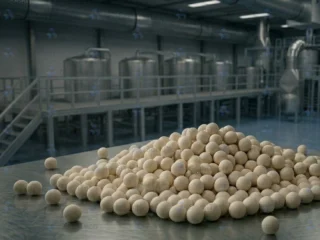 Adsorbent
Molecular Sieve 4A
Sodium form 4A zeolite, the standard drying sieve for sweet methane, refrigerant streams, and insulating glass units.
Pore Ø
4 Å
Adsorbent
Molecular Sieve 4A
Sodium form 4A zeolite, the standard drying sieve for sweet methane, refrigerant streams, and insulating glass units.
Pore Ø
4 Å
-
02
 Adsorbent
Molecular Sieve 13X
Sodium form 13X zeolite for cryogenic air pre purification and combined drying and sweetening.
Pore Ø
10 Å
Adsorbent
Molecular Sieve 13X
Sodium form 13X zeolite for cryogenic air pre purification and combined drying and sweetening.
Pore Ø
10 Å
-
03
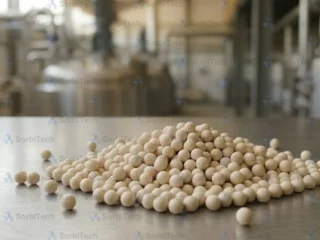 Adsorbent
Molecular Sieve 3A
Potassium form 3A zeolite, the size selective desiccant for streams that must not lose hydrocarbons to the bed.
Pore Ø
3 Å
Adsorbent
Molecular Sieve 3A
Potassium form 3A zeolite, the size selective desiccant for streams that must not lose hydrocarbons to the bed.
Pore Ø
3 Å
-
04
 Adsorbent
Carbon Molecular Sieve CMS 450HP
Ultra high purity carbon molecular sieve. 99.99999 percent (7N) N2, selective O2 and CO2 capture, 1.0 to 1.6 mm pellets, minimal fines, deoxo polishing…
Water Cap.
Feed must reach ISO 8573 class 1.4.1, deoxo polishing recommended for 7N %
Adsorbent
Carbon Molecular Sieve CMS 450HP
Ultra high purity carbon molecular sieve. 99.99999 percent (7N) N2, selective O2 and CO2 capture, 1.0 to 1.6 mm pellets, minimal fines, deoxo polishing…
Water Cap.
Feed must reach ISO 8573 class 1.4.1, deoxo polishing recommended for 7N %
-
05
 Adsorbent
Carbon Molecular Sieve CMS 420KT
High efficiency carbon molecular sieve. Higher oxygen affinity under 7 to 12 barg, 1.2 to 1.8 mm pellets, Snowstorm Filling compatible, ASTM D4058 attrition…
Water Cap.
Feed must reach ISO 8573 class 1.4.1 %
Adsorbent
Carbon Molecular Sieve CMS 420KT
High efficiency carbon molecular sieve. Higher oxygen affinity under 7 to 12 barg, 1.2 to 1.8 mm pellets, Snowstorm Filling compatible, ASTM D4058 attrition…
Water Cap.
Feed must reach ISO 8573 class 1.4.1 %
-
06
 Adsorbent
Carbon Molecular Sieve CMS 350KT
Rapid adsorption carbon molecular sieve. 40 to 90 second cycle at 7 to 10 barg, up to 99.99 percent N2, 1.0 to 2.2 mm…
Water Cap.
Moisture at supply below 1.0 percent, feed must reach ISO 8573 class 1.4.1 %
Adsorbent
Carbon Molecular Sieve CMS 350KT
Rapid adsorption carbon molecular sieve. 40 to 90 second cycle at 7 to 10 barg, up to 99.99 percent N2, 1.0 to 2.2 mm…
Water Cap.
Moisture at supply below 1.0 percent, feed must reach ISO 8573 class 1.4.1 %
Engineered Systems
-
01
 Equipment
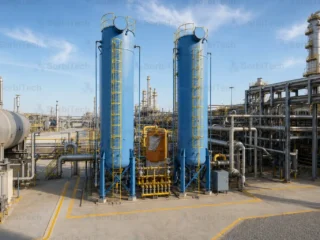
Twin Tower TSA Gas Dehydration Unit
Continuous duty temperature swing adsorption dehydration package for natural gas, engineered by SorbiTech to ASME VIII and PED, with an integrated regeneration heater and…
Capacity
0.5–200 MMSCFD (custom engineered)
Equipment
Twin Tower TSA Gas Dehydration Unit
Continuous duty temperature swing adsorption dehydration package for natural gas, engineered by SorbiTech to ASME VIII and PED, with an integrated regeneration heater and…
Capacity
0.5–200 MMSCFD (custom engineered)
-
02
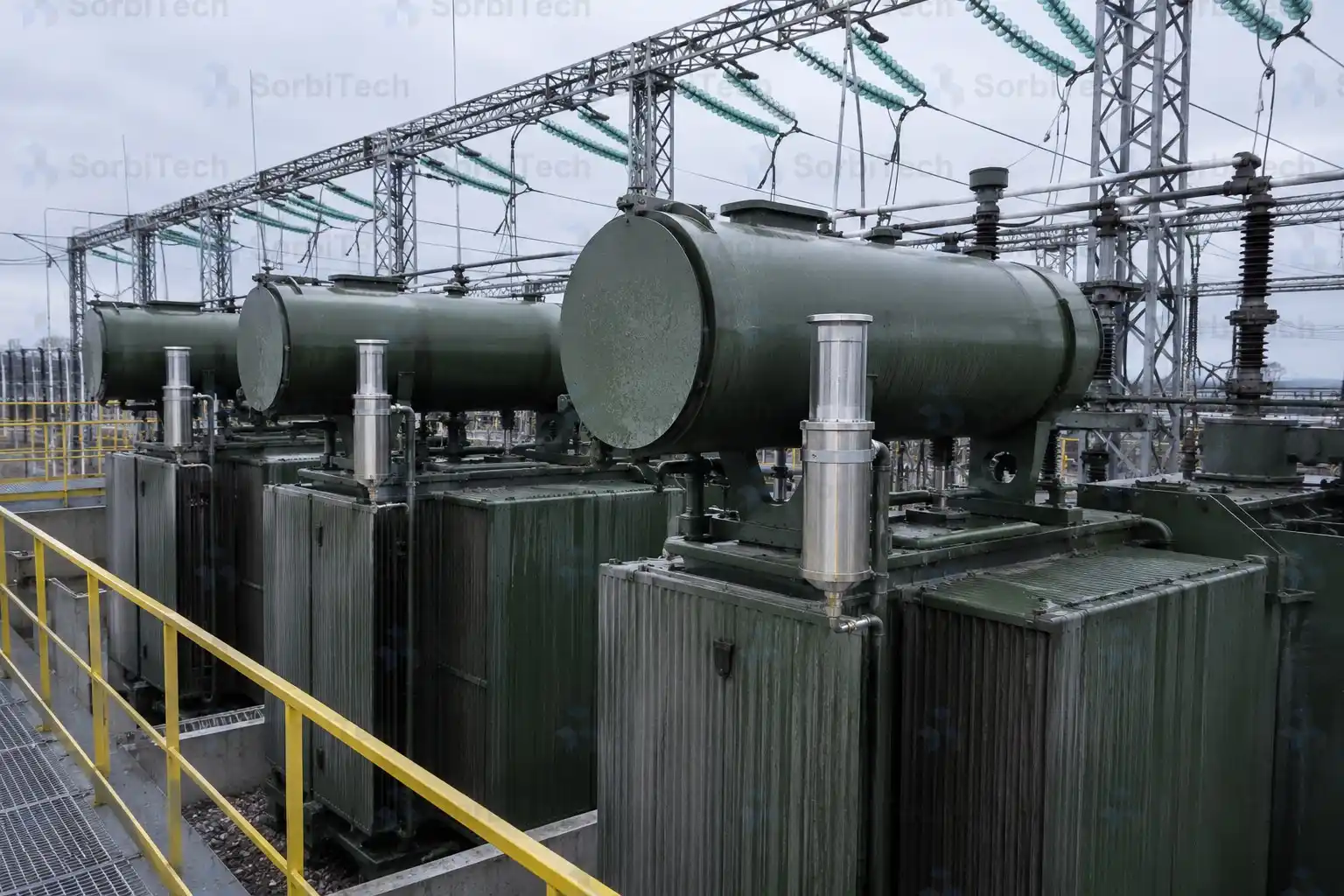 Equipment
Transformer Breather Cartridge System
Pre packaged stainless steel transformer breather cartridge with indicating silica gel for grid transformer moisture protection across the high voltage transmission and distribution network.
Capacity
0.5–25 kVA transformer to 800 kV substation
Equipment
Transformer Breather Cartridge System
Pre packaged stainless steel transformer breather cartridge with indicating silica gel for grid transformer moisture protection across the high voltage transmission and distribution network.
Capacity
0.5–25 kVA transformer to 800 kV substation
-
03
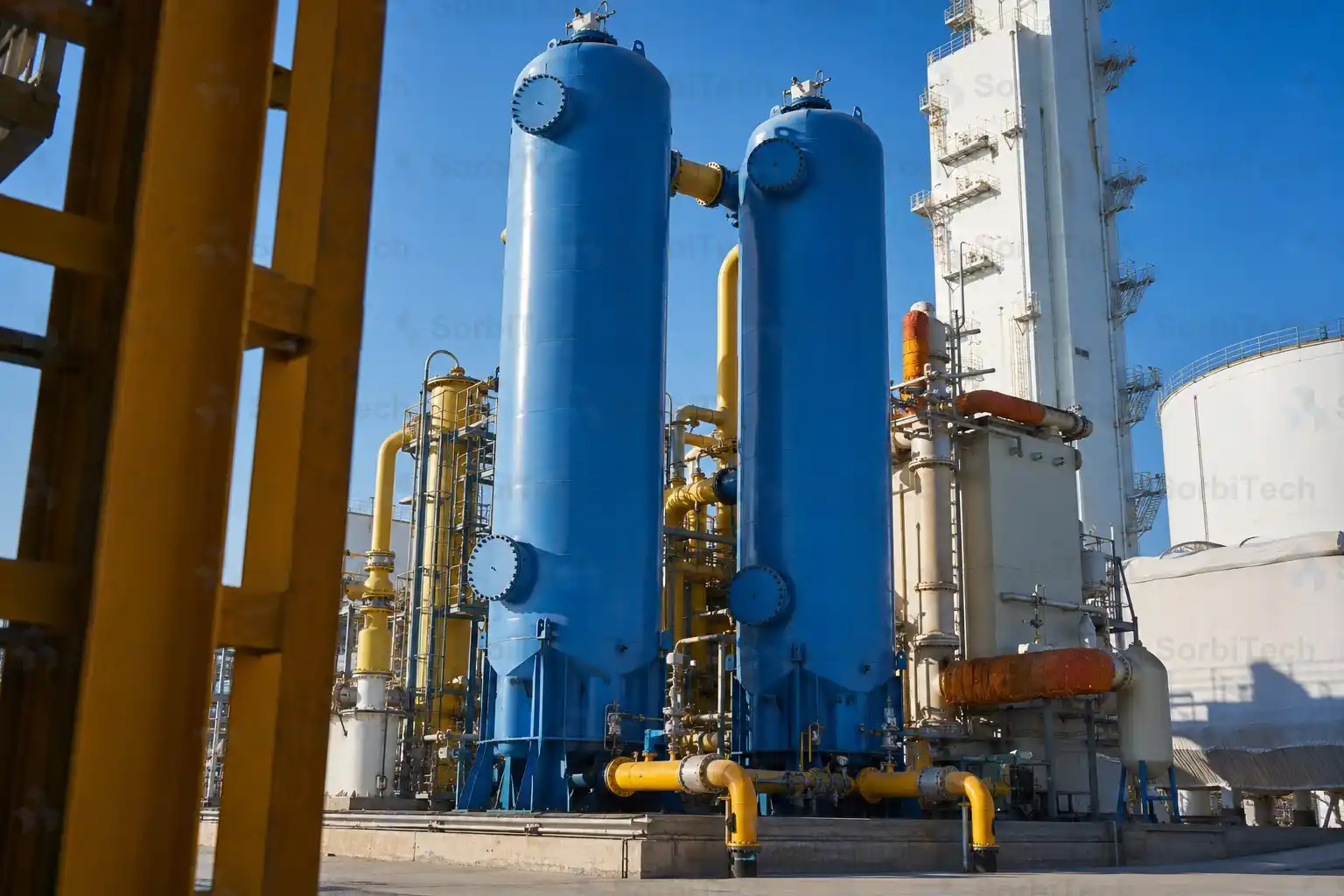 Equipment
Cryogenic ASU Pre Purification Package
Front end TSA pre purification package for cryogenic air separation units removing water, carbon dioxide, and trace hydrocarbons before the cold box.
Capacity
5,000–500,000 Nm³/h air
Equipment
Cryogenic ASU Pre Purification Package
Front end TSA pre purification package for cryogenic air separation units removing water, carbon dioxide, and trace hydrocarbons before the cold box.
Capacity
5,000–500,000 Nm³/h air
-
04
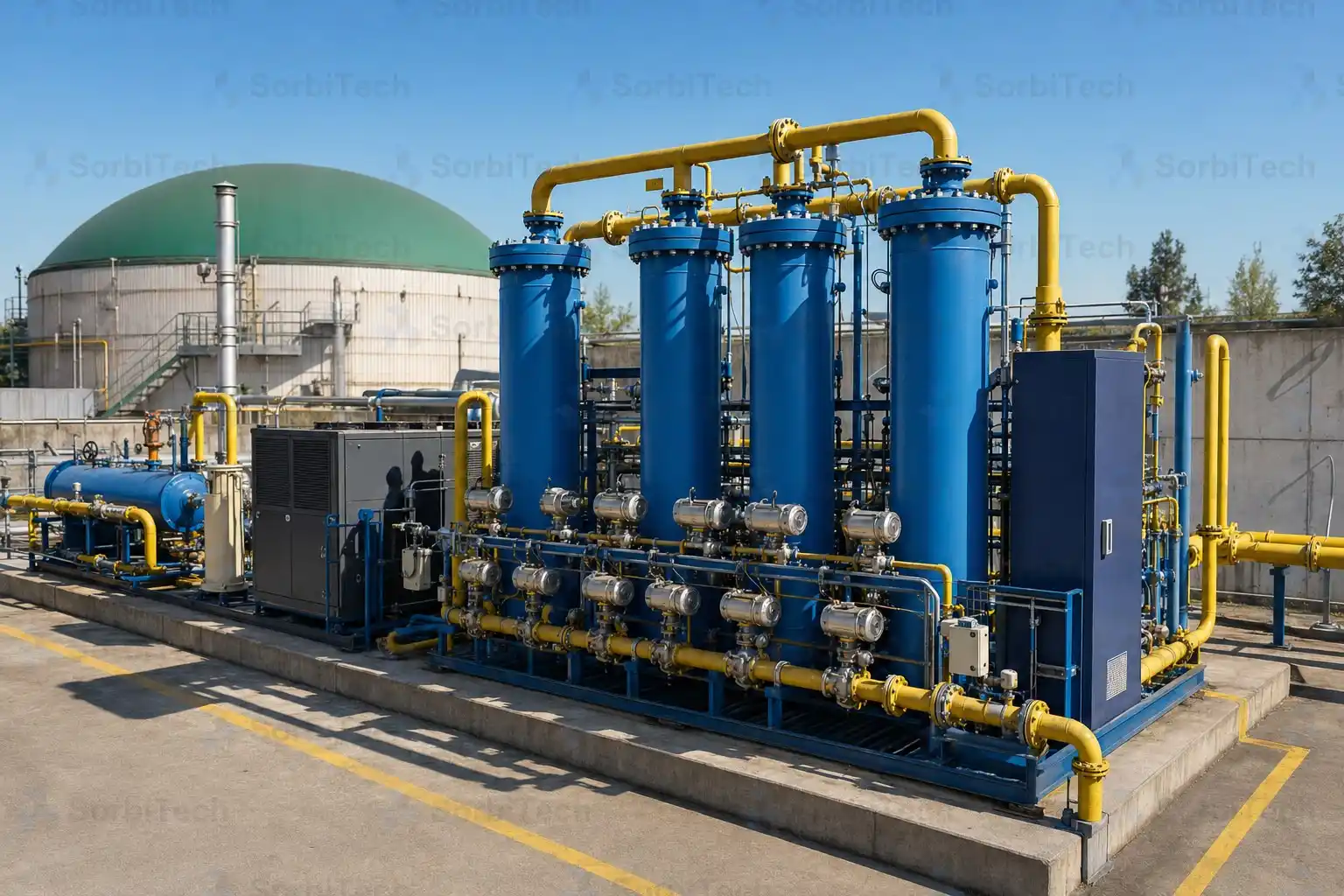 Equipment
Biogas Upgrading Unit
PSA biogas upgrading unit using carbon molecular sieve to separate carbon dioxide from methane and deliver grid quality bio methane from anaerobic digester biogas…
Capacity
50–2,000 Nm³/h raw biogas
Equipment
Biogas Upgrading Unit
PSA biogas upgrading unit using carbon molecular sieve to separate carbon dioxide from methane and deliver grid quality bio methane from anaerobic digester biogas…
Capacity
50–2,000 Nm³/h raw biogas
-
05
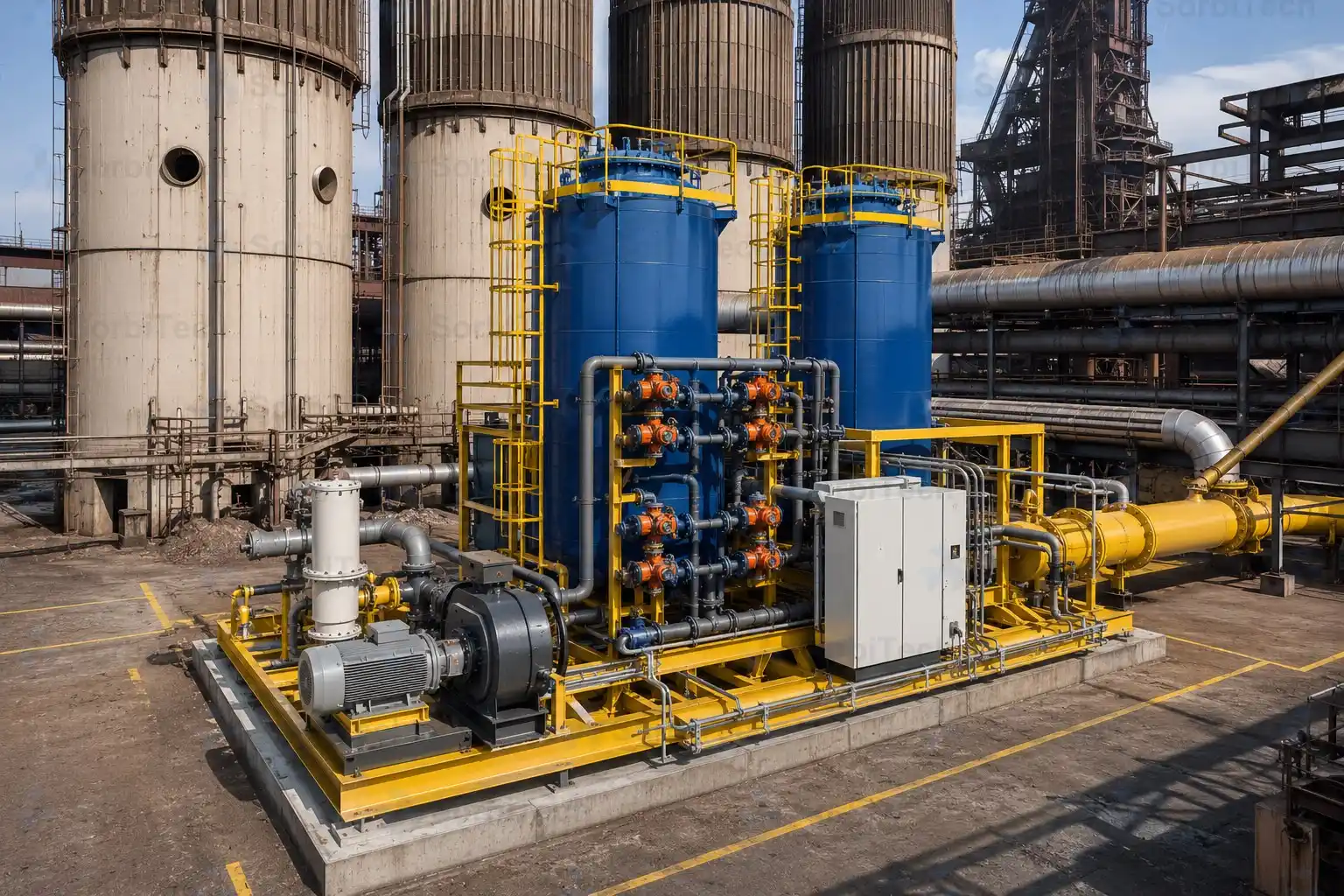 Equipment
Oxygen VPSA Package
On site vacuum pressure swing adsorption (VPSA) oxygen generation package delivering 90 to 95 percent oxygen for medical, aquaculture, ozone generation, and metals applications.
Capacity
50–2,500 Nm³/h O₂ (90–95 % purity)
Equipment
Oxygen VPSA Package
On site vacuum pressure swing adsorption (VPSA) oxygen generation package delivering 90 to 95 percent oxygen for medical, aquaculture, ozone generation, and metals applications.
Capacity
50–2,500 Nm³/h O₂ (90–95 % purity)
-
06
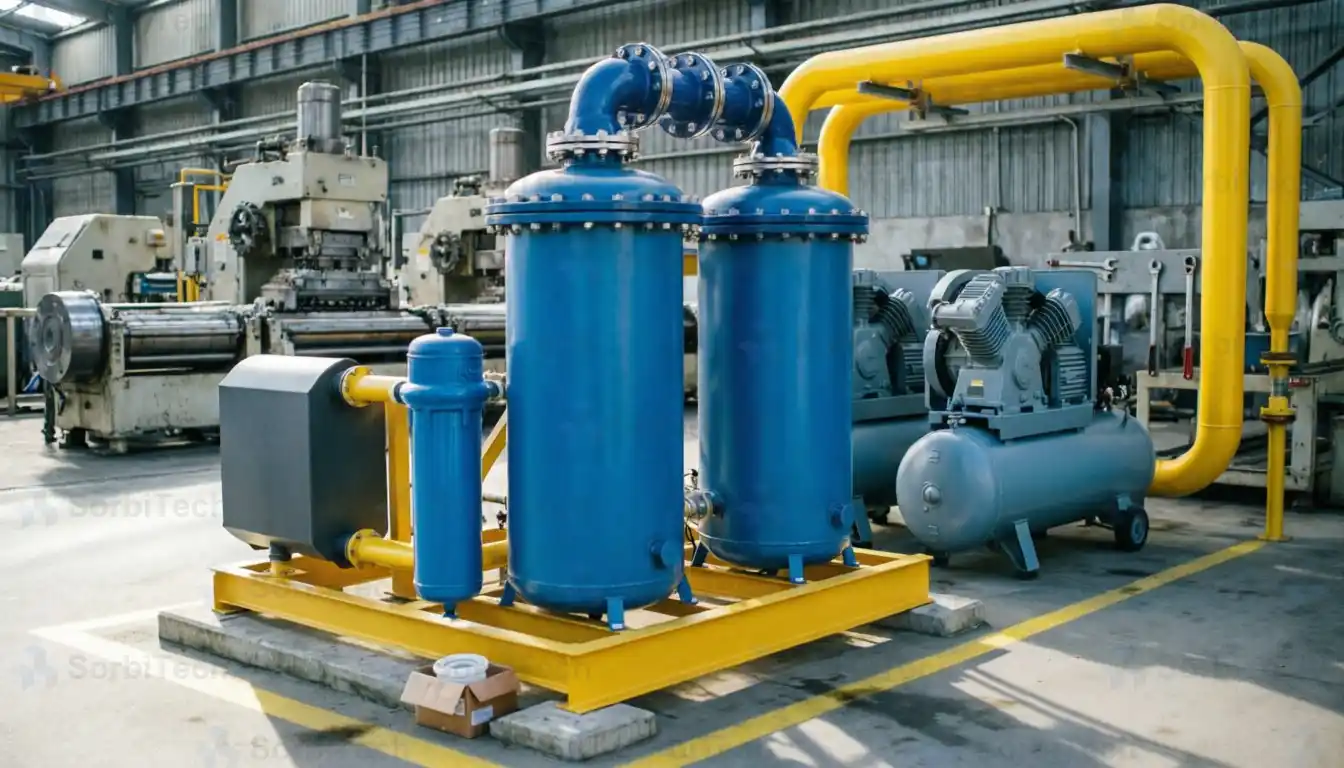 Equipment
Heatless Desiccant Air Dryer
Twin tower heatless desiccant compressed air dryer using activated alumina or silica gel for instrument and process air to pressure dew points below minus…
Capacity
50–10,000 Nm³/h
Equipment
Heatless Desiccant Air Dryer
Twin tower heatless desiccant compressed air dryer using activated alumina or silica gel for instrument and process air to pressure dew points below minus…
Capacity
50–10,000 Nm³/h
Industries Using This Application
-
01
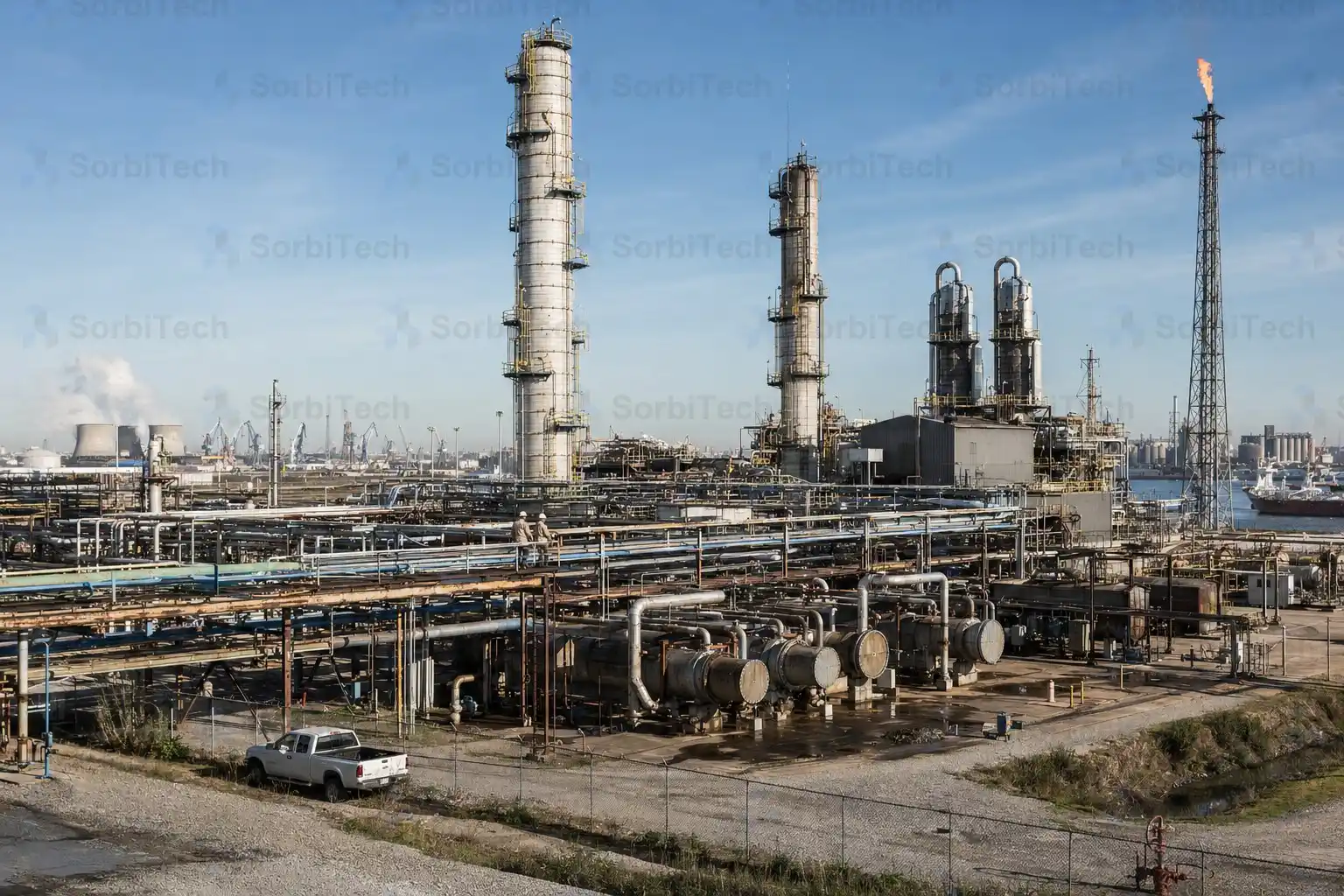 Sector
Petrochemicals & Refining
Adsorbents and separation systems for feedstock drying, process gas conditioning, solvent recovery, and refinery effluent treatment.
Sector
Petrochemicals & Refining
Adsorbents and separation systems for feedstock drying, process gas conditioning, solvent recovery, and refinery effluent treatment.
-
02
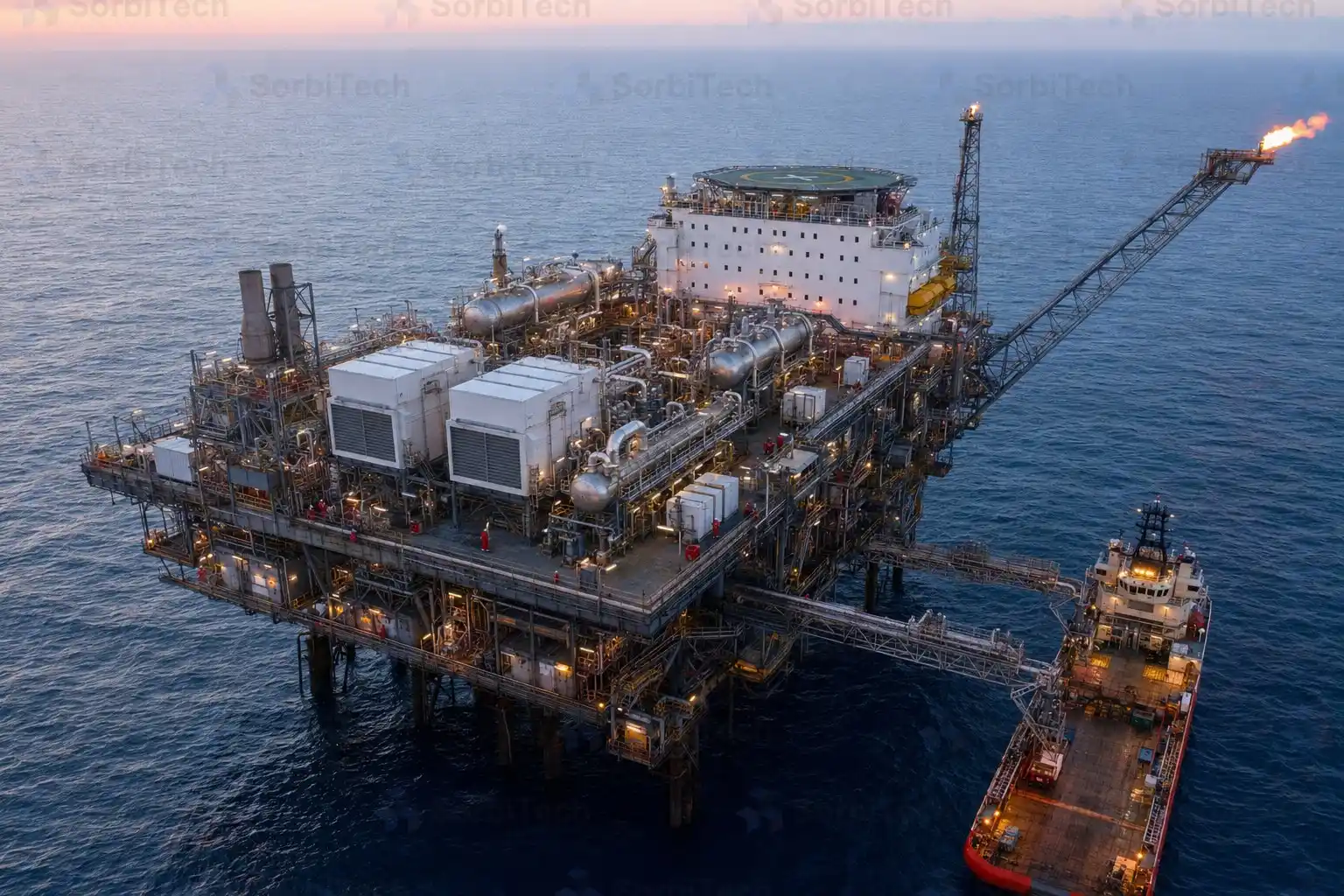 Sector
Oil & Gas
Complete dehydration, separation, and treatment across upstream, midstream, and downstream oil and gas. SorbiTech supplies the adsorbent media and the engineered systems from one…
Sector
Oil & Gas
Complete dehydration, separation, and treatment across upstream, midstream, and downstream oil and gas. SorbiTech supplies the adsorbent media and the engineered systems from one…
Specify a Solution for This Application
Provide your process conditions and our team will recommend the grade, configuration, and sizing.