
Air is separated by how fast molecules move, not by how large they are
Dry compressed air is roughly 78 percent nitrogen, 21 percent oxygen and about 1 percent argon. Separating the nitrogen from the oxygen looks difficult, because the two molecules are nearly identical in size. Oxygen has a kinetic diameter of about 3.46 angstrom and nitrogen about 3.64 angstrom. That difference is less than 6 percent, far too small for a filter to act on.
The solution is to stop thinking about size and start thinking about speed. The carbon adsorbent contains a network of pore constrictions in the same size range as the molecules themselves. In a passage that narrow, a very small size advantage becomes a very large speed advantage. Oxygen slips into the pore network quickly, while nitrogen takes far longer to make the same journey. Published figures for that rate difference vary with the grade and the conditions, but it is commonly described as being more than an order of magnitude.
This is what the word kinetic means in this context. The bed is not selective because it holds more oxygen at equilibrium. Given unlimited time, both gases would eventually fill the pores. The bed is selective because the process never gives them unlimited time. The cycle is deliberately kept short, so oxygen is taken up and nitrogen is still in the flowing gas when the product leaves the vessel.
It is worth contrasting this with the more familiar equilibrium adsorbents. A crystalline molecular sieve separates mainly by pore size exclusion and by how strongly each molecule is attracted to the surface, which is why on site oxygen generation uses a lithium exchanged zeolite that holds nitrogen and lets oxygen through. The two technologies look similar from the outside and work on opposite principles.
The retained oxygen is released by dropping the pressure, not by adding heat
Adsorption is driven by pressure. When compressed air is admitted to a vessel, oxygen is driven into the pores and held there. When that pressure is released, the driving force reverses and the trapped oxygen comes back out, leaving the bed ready to work again.
This matters more than it first appears. Because regeneration needs no thermal energy, a vessel can be brought back into service in seconds rather than the hours a heated cycle would require. That short recovery time is what makes a continuous two vessel arrangement practical, and it is the reason the process is described as a pressure swing rather than a temperature swing.
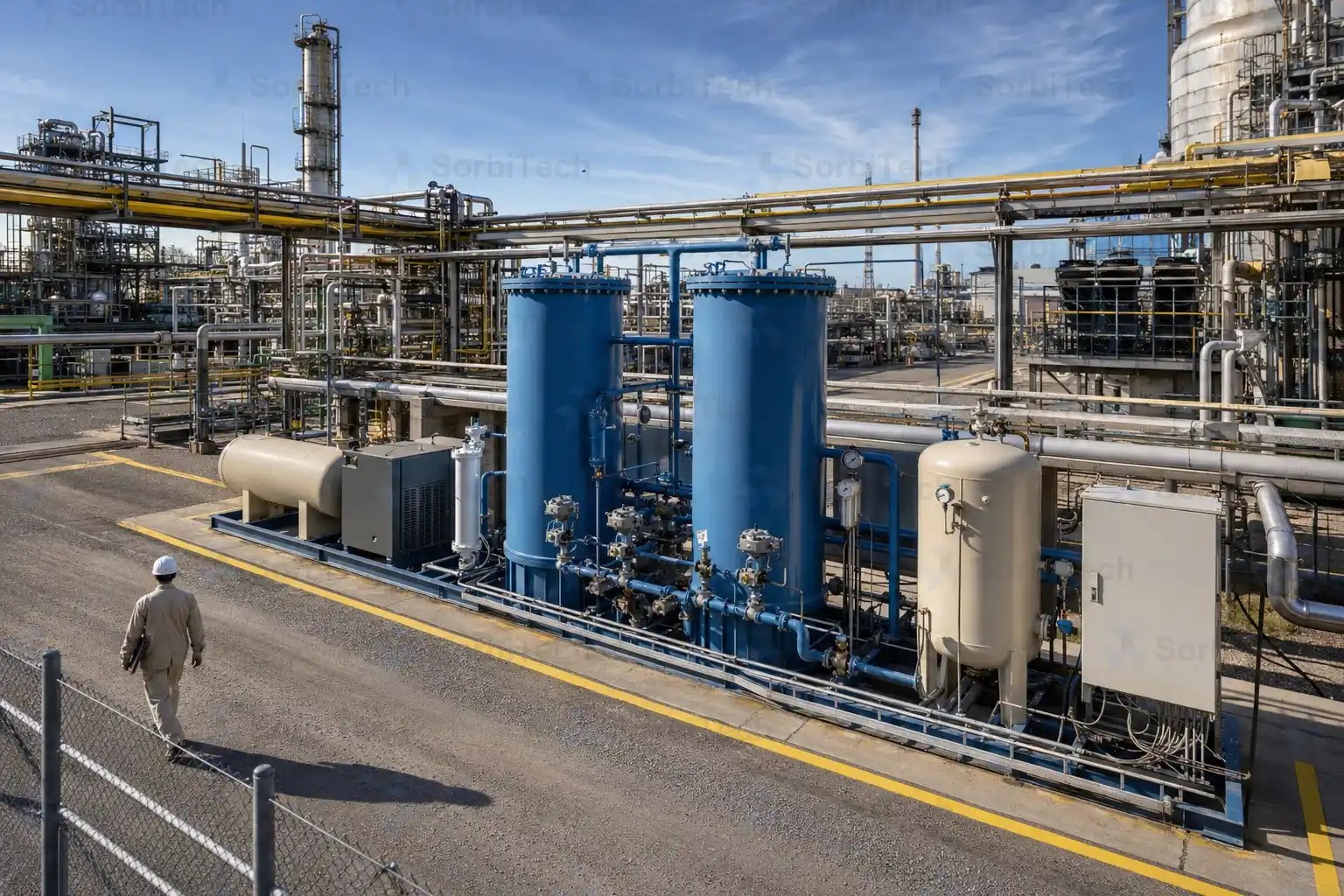
While one vessel is on line and delivering product, the other is venting its oxygen rich gas to atmosphere. A short equalisation step passes some of the pressure from the finishing vessel into the starting vessel before the swap, which recovers energy that would otherwise be lost and reduces the pressure shock on the bed. The vessels then exchange duties and the sequence repeats indefinitely. The engineered arrangement of vessels, valves and control is what is supplied as an on site nitrogen generation package.
Purity, recovery and air consumption are set together, not independently
During the productive step, a front of oxygen advances slowly through the bed. The operator gets to choose when to stop. Stopping early, well before that front approaches the outlet, gives very clean nitrogen but wastes the unused capacity behind it. Running longer recovers far more nitrogen from the same air, but risks oxygen breaking through into the product.
This single trade off explains most of what is otherwise puzzling about these systems. It is why cycle times are typically measured in tens of seconds rather than minutes, and it is why the compressed air required per unit of nitrogen climbs so steeply as the purity specification tightens. Moving from a blanketing duty at around 95 percent to a high purity duty above 99.99 percent can multiply the air demand several times over.
The practical consequence for a plant is straightforward. Purity should be specified from what the process genuinely requires, not from what sounds safe. Since compressed air is usually the largest running cost of the installation, an over specified purity target is paid for every hour of every year. Feed conditions matter for the same reason, and a stable, properly dried supply from the compressed air drying and purification stage upstream protects both performance and bed life.
The adsorbent sets the ceiling on purity and the size of the air bill
Everything above describes what the process does. What decides how well it does it is the material in the vessels. Two properties carry most of the weight. The first is kinetic selectivity, meaning how much faster oxygen enters the pores than nitrogen does, which governs how clean the product can be. The second is working capacity, meaning how much oxygen each cycle actually removes, which governs how much nitrogen is recovered from a given volume of air.
A vessel loaded with an adsorbent of modest selectivity cannot reach a high purity target at any cycle time. It can only be pushed by shortening the productive step, which raises air consumption until the economics fail. This is why the carbon molecular sieve properties quoted for a grade should be read as design limits for the whole installation rather than as a materials data sheet. Selectivity sets what is achievable and working capacity sets what it costs.
Grades are formulated for different points on that curve, and the purity requirement is normally the first thing to fix when choosing among them.
| Grade | Typical duty | Indicative nitrogen purity |
|---|---|---|
| CMS 260L | Medium flow, general industrial service | About 95 to 99.9 percent |
| CMS 350KT | Rapid adsorption, shorter cycles | Up to about 99.99 percent |
| CMS 420KT | High efficiency, higher operating pressure | High purity industrial service |
| CMS 450HP | Ultra high purity with downstream deoxo polishing | Up to about 99.99999 percent |
Values are indicative and depend on operating pressure, cycle time, temperature and bed sizing. Confirm the duty against the actual design case.
Pellet consistency and dense loading protect performance over the life of the bed
A bed that performs well on commissioning day can drift over the following years, and the reasons are usually mechanical rather than chemical. Every pressure cycle moves the bed slightly. Pellets that are soft or poorly sized abrade against one another and generate fines, which migrate, increase pressure drop and can foul downstream valves. A settled bed can also leave voids at the top, and gas that finds a preferential path through a void bypasses the adsorbent instead of being treated by it.
This is why attrition resistance and a narrow size distribution are worth as much attention as the headline separation figures, and why carbon molecular sieve pellets are normally specified with a defined diameter range and a verified attrition standard. It is also why dense loading techniques such as snowstorm filling are used in place of simple pouring. Distributing pellets evenly as they fall produces a tighter, more uniform packing that resists settling, which is the practical difference between a bed that holds its purity for years and one that quietly loses ground each season.
Where on site generation is chosen over delivered nitrogen
Generating nitrogen on site removes the logistics of cylinders and liquid deliveries and gives a plant a supply it controls. It is common wherever an inert atmosphere is needed continuously, including tank blanketing, purging and pressure transfer, laser cutting, controlled atmosphere packaging, heat treatment and pharmaceutical processing. The duty as a whole is covered under PSA nitrogen generation, and it sits alongside the other separation duties served across industrial gas and air separation.
For a new installation, the sequence that avoids most problems is to fix the genuine purity and flow requirement first, size the compressed air supply against it honestly, and only then select the carbon molecular sieve for nitrogen generation that meets the duty with margin. Reversing that order, by choosing hardware first and discovering the air demand later, is the most common reason an installation disappoints.
Frequently asked questions
Why is oxygen captured instead of nitrogen when both molecules are almost the same size?
Separation is governed by the rate at which each molecule enters the micropores rather than by size exclusion. Oxygen has a slightly smaller kinetic diameter, near 3.46 angstrom against about 3.64 angstrom for nitrogen, and in a pore network tuned to that range it diffuses inward far faster. Within the seconds available in a cycle, oxygen is taken up and nitrogen largely stays in the gas phase and leaves as product.
Why does higher nitrogen purity increase compressed air consumption so sharply?
Higher purity is obtained by ending the adsorption step earlier, before the leading edge of oxygen reaches the outlet. A shorter productive step recovers less nitrogen from the same volume of air, so the air required per unit of nitrogen rises steeply as purity targets tighten. Purity, recovery and energy are linked and cannot be optimised independently.
Does the adsorbent need heating to regenerate?
No. Regeneration is achieved by releasing pressure, which reverses the driving force and allows the retained oxygen to leave the pores. Because no thermal energy is applied, the vessel returns to service within seconds rather than hours, which is what allows two vessels to alternate continuously.
What happens to argon in the product nitrogen?
Argon makes up roughly one percent of air and is not separated efficiently by this mechanism, so it tends to carry through with the nitrogen. Where a specification is written on residual oxygen content this is normally of no consequence. Where an inert gas specification is written on total impurities, the argon fraction should be accounted for at the design stage.
Matching an adsorbent to your nitrogen duty
Share your purity, flow and available air pressure, and our engineers will advise on a suitable grade.